
What commercial site preparation involves in Washington — clearing, mass grading, utilities, stormwater and inspection sequencing on larger developments.
Commercial site preparation is the phase that determines whether the rest of a project runs on schedule or fights the ground the whole way up. It is also the phase most often underestimated at bid time, because from the outside it looks like moving dirt — and it is far more than that.
This is a working overview for general contractors, developers and property managers evaluating what a commercial site package actually involves in Washington State, and where the real risk sits.
What Commercial Site Preparation Covers
On a commercial development, site preparation is everything that happens between a raw or existing parcel and a pad ready for vertical construction. On most projects that means:
- Clearing and demolition — removing existing vegetation, structures, slabs and hardscape, and disposing of the material at the correct facilities
- Mass grading — cutting and filling across the site to bring it to design subgrade, balancing earthwork on site where possible to limit import and export
- Erosion and sediment control — perimeter protection, inlet protection and stabilised construction entrances, installed before disturbance and maintained throughout
- Utility infrastructure — trenching and installing water, sewer, storm, power and communications to the building envelope and out to the connections
- Stormwater systems — detention, retention, bioretention or vaults, which on many Washington commercial sites are the single largest earthwork element
- Structural fill and subgrade preparation — over-excavating unsuitable material and replacing it with engineered fill compacted in lifts, then proof-rolling to a spec the geotechnical engineer will sign
Each of these is a discipline. Sequenced wrong, they undo each other — grading before erosion control, or utilities after the pad is compacted, turns into rework that shows up on the critical path.
Permitting Comes First, Not Second
The most expensive scheduling mistake on commercial site work is treating permits as a parallel task instead of a predecessor. In most Washington jurisdictions a commercial project touches several separate approvals:
- A grading or land-disturbing activity permit, triggered by volume of earth moved or area disturbed
- A stormwater review under the jurisdiction’s adopted manual — many follow the Washington State Department of Ecology standards, applied locally
- A clearing permit, sometimes bundled with grading and sometimes separate
- Critical-area review where wetlands, streams, steep slopes or their buffers are in play
The thresholds differ between county and city, and between neighbouring cities. A site straddling a boundary can answer to two regimes at once. Mapping the full permitting path before earthwork begins is not administrative overhead — it is schedule protection, because the approval timeline routinely exceeds the physical work.
Where the Money Actually Goes
Commercial earthwork is priced on volume, haul and subsurface risk far more than on acreage. Three factors move a bid more than anything else.
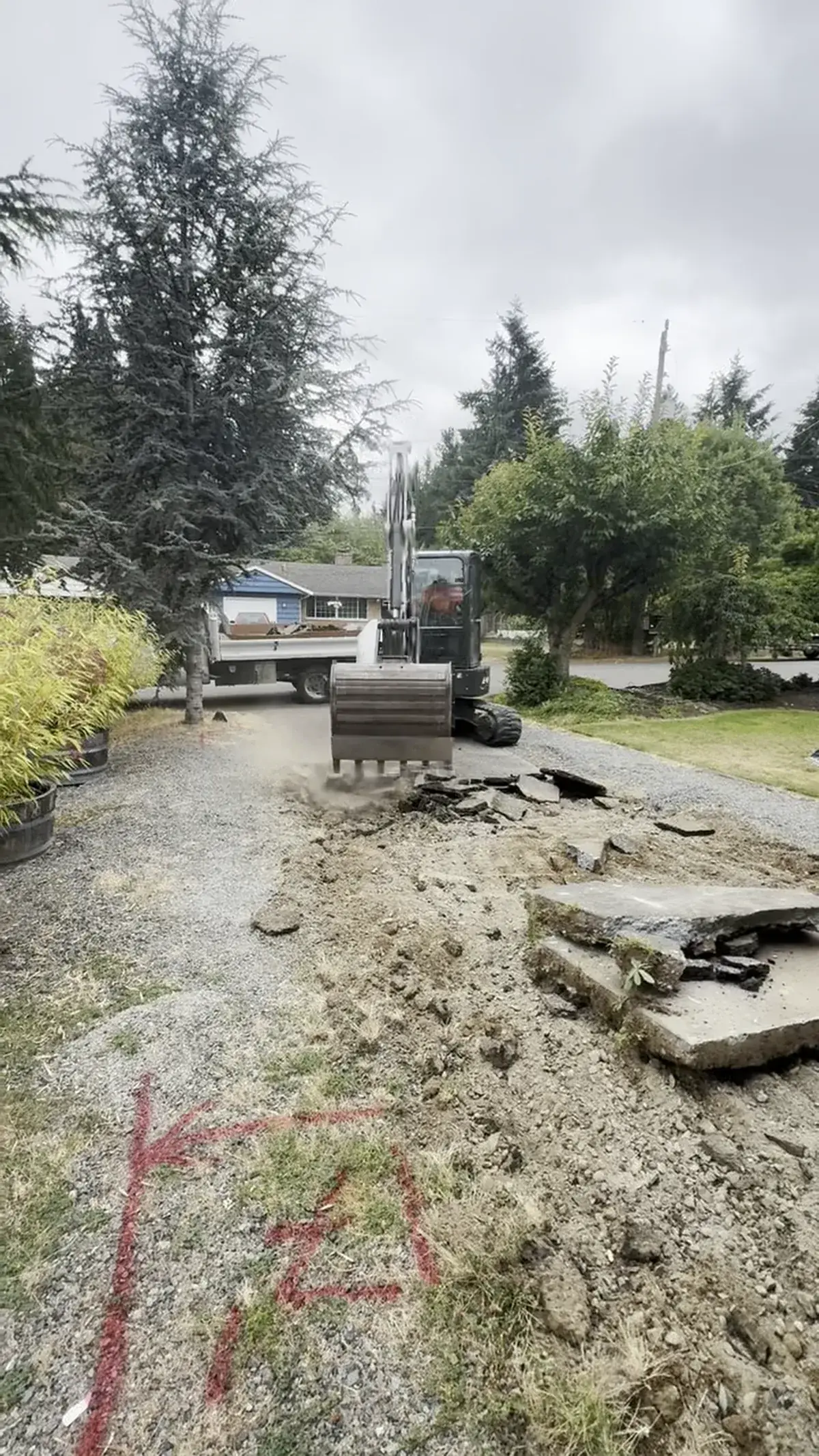
Earthwork Balance
A site that balances — where cut volume roughly equals fill volume — avoids the cost of importing structural fill or exporting spoil. A site that does not balance pays for trucking in both directions, and on a large development that is a very large number. The grading design drives this, and it is worth understanding the balance before the bids come in.
Subsurface Conditions
This is where commercial jobs are won and lost. A geotechnical report gives everyone a shared basis, but borings are point samples — they do not guarantee what sits between them. Rock, high groundwater, soft soils requiring over-excavation, and buried debris from prior use are the conditions that turn a clean bid into a change-order fight. A professional bid prices the known conditions from the geotech and carries explicit written exclusions for what the borings could not reach.
Disposal and Haul Logistics
Where material goes, and how far, is a major line item. Clean fill, contaminated soil, concrete, and green waste all go to different facilities at different rates. On sites with contaminated or unsuitable material, disposal can rival the cost of the excavation itself. A site crew that owns its trucks controls this directly rather than marking up a subcontracted hauler and waiting on their availability.
The Subcontractor Question
For a general contractor, the site preparation sub sets the tone for the whole build. A crew that hits subgrade to plan, sequences cleanly around inspections, and keeps the site moving is the difference between breaking ground on schedule and starting three weeks behind.
The single most underrated attribute is haul capacity. A site sub without its own trucks is dependent on a third party showing up, and when that hauler is busy, the excavation stalls with a spoil pile sitting in the middle of the site. A sub that owns its fleet removes that dependency entirely — the dirt leaves when the dig finishes, not when someone else has an opening.
Sequencing That Protects the Schedule
The order of operations on a commercial site is not arbitrary. A defensible sequence looks like:
- Permits secured and preconstruction meeting held — nothing disturbs the ground first
- Erosion and sediment control installed — perimeter and entrance before any clearing
- Clearing and demolition — vegetation and structures removed, debris sorted and hauled
- Mass grading to subgrade — cut and fill balanced, unsuitable material over-excavated
- Utility installation — trenched and backfilled before the pad is finalised
- Stormwater infrastructure — detention and conveyance built to the approved design
- Structural fill and pad preparation — engineered fill compacted in lifts, proof-rolled, and inspected
- Final subgrade and inspection — held to plan elevations and signed off before vertical work
Skip or reorder a step and the rework lands on the critical path, where it is most expensive.
The Bottom Line
Commercial site preparation rewards planning and punishes optimism. The projects that run smoothly are the ones where permitting started early, the geotechnical risk was priced honestly, and the site crew had the equipment and trucks to keep material moving without waiting on anyone.
DirtRaptor handles commercial site preparation across Snohomish, King, Skagit and Pierce County — clearing, mass grading, utilities and drainage, with our own fleet and no subcontracted haul-off in the chain. For a walk-through and a real number on your next development, request a quote.
Frequently Asked Questions
How long does commercial site preparation take?
+
It depends almost entirely on acreage, earthwork volume and permitting. Physical site work on a small commercial pad can run a few weeks; a multi-acre development with mass grading, stormwater infrastructure and utility runs is measured in months. Permitting frequently takes longer than the earthwork itself, which is why it belongs at the front of the schedule rather than the middle.
What permits does commercial site work require in Washington?
+
Most commercial projects need a grading permit, a stormwater or drainage review, and often a land-disturbance or clearing permit — each triggered by different thresholds and each handled differently by county versus city. Critical-area review adds another layer near wetlands, streams or steep slopes. The specific set depends on the jurisdiction and the site, which is why the permitting path should be mapped before dirt moves.
Should a general contractor self-perform site work or subcontract it?
+
Most GCs subcontract earthwork to a specialist, because the equipment, operators and disposal logistics are a different business from vertical construction. The value of a good site sub is a crew that hits grade to plan, sequences around inspections, and does not stall the whole project waiting on haul-off. That last point is where a sub that owns its own trucks materially outperforms one that does not.
What is the biggest cost risk on a commercial site preparation job?
+
Unsuitable soils and undocumented subsurface conditions. A geotechnical report reduces the risk but never eliminates it — rock, high groundwater, buried debris and soft soils requiring over-excavation and structural fill are the line items that blow budgets. A defensible bid prices known conditions and carries explicit, written exclusions for what the borings did not reach.
Related Services
